

Last Updated: November 15, 2026
Quick Summary
What makes Indian food authentic is regional origin, freshly ground whole spices, traditional cooking methods, and a deliberate balance of flavour, aroma, colour and texture, not heat or a single recipe. Authenticity is a set of cooking decisions rather than a fixed menu, so the same dish can taste entirely different from one Indian household to the next.
- Authenticity rests on four pillars: regional origin, whole spices, traditional technique and balance.
- There is no single authentic Indian style because regional cuisines developed around different climates, crops and traditions.
- Toast whole spices first, temper them in hot fat, then grind fresh to keep flavour potent.
- Start with one region at home and stock four whole spices: cumin, coriander, turmeric and dried chilli.
- Judge a menu by whether it names regions, describes preparation and offers dishes beyond the Punjabi core.
Table of Contents
- What Authenticity Really Means in Indian Cooking
- Regional Indian Food: Why There Is No Single Authentic Style
- Indian Spices and Cooking Techniques That Define the Flavour
- Authentic Indian Food vs Westernised Curry: How to Tell the Difference
- How to Cook Authentic Indian Food at Home
- How to Judge an Authentic Indian Restaurant Menu in Sheffield
- Book a Table at Mezwaani and Taste the Difference
- Frequently Asked Questions
What Authenticity Really Means in Indian Cooking
What makes Indian food authentic is not heat or a single recipe, but regional origin, freshly ground whole spices, traditional cooking methods, and a deliberate balance of flavour, aroma, colour and texture.
The word “authentic” gets used loosely on British high streets. Most menus use it to mean “not from a jar”. That is a low bar. Real authenticity starts with where a dish comes from and how it is built, not with how much chilli it carries.
The Four Pillars of an Authentic Dish
Authenticity can be judged against four pillars, and a restaurant that fails any one of them is adapting rather than cooking traditionally:
- Regional origin. The dish belongs to a named region, not a generic “Indian” category.
- Whole spices. Cumin, coriander, cardamom and cinnamon are toasted and ground in-house, not replaced by a blended curry powder.
- Traditional technique. Tempering, slow cooking and marination are used because they change the result, not as a marketing line.
- Balance. Heat, sourness, sweetness and aroma sit in proportion, with texture and colour doing equal work.
Regional Indian Food: Why There Is No Single Authentic Style
There is no single authentic Indian style because India’s regional cuisines developed around different climates, crops, religious traditions and household recipes.
This is the part most guides get wrong. They present one national menu and call it authentic, when regional diversity is the whole point. A Goan fish curry and a Kashmiri rogan josh share a country and almost nothing else.
How the Major Regional Cuisines Differ
A useful way to read an Indian menu is to group dishes by the region they come from, because each region’s cooking is shaped by its climate, its staple crop and its religious and trading history. The table below sets out the distinctions most commonly found in British Indian restaurants, including those in Sheffield.
- Punjabi. Wheat, dairy and the tandoor dominate. Dishes such as sarson da saag with makki di roti, butter chicken and dal makhani rely on ghee, cream and slow cooking. Punjabi food is the backbone of most British Indian restaurant menus, which is why it is often mistaken for “Indian food” as a whole.
- Gujarati. Vegetarian and often sweet-sour, with a strong tradition of thali dining. Dishes such as dhokla, undhiyu and Gujarati kadhi use gram flour, yogurt, jaggery and mustard seeds. Gujarati cooking is one of the clearest tests of a kitchen’s range because it cannot lean on meat or heavy cream.
- Bengali. Fish, mustard oil, panch phoron (a five-spice mix of nigella, fenugreek, mustard, cumin and fennel) and a subtle sweetness from sugar or fruit. Dishes such as macher jhol and shorshe ilish taste quite different from Punjabi curries, and Bengali food is underrepresented on many British high streets.
What This Means for Diners in Sheffield
British Indian restaurant menus have historically been built around Punjabi-derived dishes, and the range now runs well beyond that core.
Watch out: a dish labelled “South Indian” on a menu that otherwise sells only Punjabi-style curries is worth questioning, because South Indian cooking depends on fermentation, rice batters and coconut that a single-sauce kitchen is not set up to produce.
Seasonal ingredients and local sourcing drive regional difference as much as spice does.
NHS guidance on eating a balanced diet
Each region’s cooking is shaped by its climate, staple crop and history, so here is how the major cuisines differ.
| Region | Staples and signature ingredients | Dishes to look for |
|---|---|---|
| Punjabi | Wheat, dairy, tandoor, ghee and cream | Sarson da saag, butter chicken, dal makhani |
| Gujarati | Vegetarian, gram flour, yogurt, jaggery, mustard seeds | Dhokla, undhiyu, Gujarati kadhi |
| Bengali | Fish, mustard oil, panch phoron, subtle sweetness | Macher jhol, shorshe ilish |
| South Indian | Rice, lentils, coconut, tamarind, curry leaves | Dosa, idli, sambar, rasam, Chettinad chicken |
| Goan | Vinegar, pork, coconut, Portuguese influence | Vindaloo, xacuti |
| Kashmiri | Yogurt gravies, fennel, dried ginger, Kashmiri chilli | Rogan josh, dum aloo |
Indian Spices and Cooking Techniques That Define the Flavour
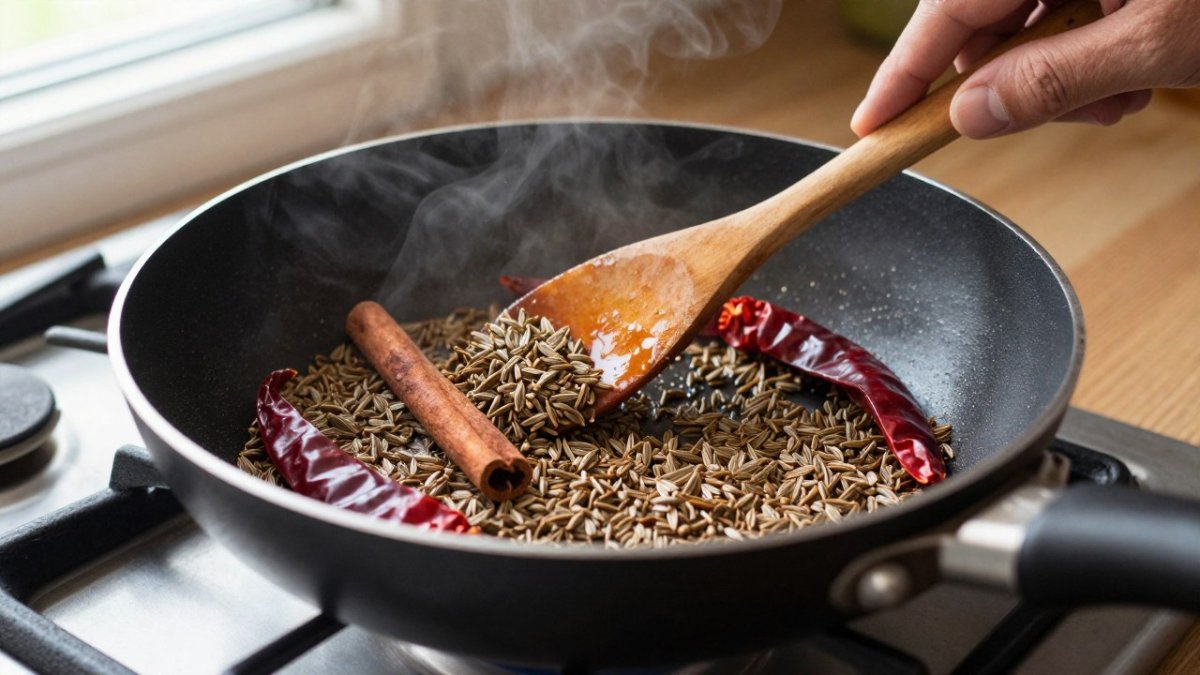
Indian spices and cooking techniques define flavour through layering: whole spices are toasted to release their oils, tempered in hot fat to bloom their aroma, then ground fresh so the volatile spice compounds survive into the pan.
Fresh coriander, curry leaves and green chilli are often added late, because heat can dull what makes them taste of themselves.
Toasting, Tempering and Grinding: The Steps That Build Depth
Toasting comes first: dry-roast whole spices in a pan until they smell nutty, then cool them. Tempering follows, frying them briefly in ghee or oil so the fat carries their aroma through the dish. Grinding last keeps the powder potent. For a deeper look at how these layers combine, read our guide to authentic spice profiles in cooking.
Authentic Indian Food vs Westernised Curry: How to Tell the Difference
Authentic Indian food and Westernised curry diverge at the base: traditional dishes build flavour from whole spices toasted and ground for that recipe, while British Indian curry often starts from a pre-mixed curry powder and a thickened sauce.
Watch for these tells:
- One sauce, many dishes. If every curry tastes the same, the base is shared.
- Colour without aroma. Bright red without fragrance usually means food colouring.
- No texture contrast. Authentic plates mix creamy, crunchy and fresh elements.
Adaptation is not a crime, but it does raise the question of what makes Indian food authentic. If you want to understand why the real thing runs hotter and deeper, our piece on why authentic Indian food tastes so spicy explains the layering.
How to Cook Authentic Indian Food at Home
You can cook authentic Indian food at home by buying whole spices, grinding them fresh, and accepting that slow cooking and marination do more for flavour than any shortcut. Start with one region rather than the whole subcontinent.
A workable sequence:
- Stock four whole spices. Cumin, coriander, turmeric root or good powder, and dried chilli cover most everyday dishes.
- Toast and grind in small batches. A coffee grinder works; make only what you will use in a few weeks.
- Marinate proteins for at least an hour. Yogurt and acid tenderise and carry spice into the centre.
- Temper at the start and finish. Whole seeds in hot fat at the beginning, fresh herbs at the end.
- Cook lentils low and long. They reward patience more than any other ingredient.
A common mistake is adding every spice at once. Add them in the order the recipe intends, and taste between stages.
How to Judge an Authentic Indian Restaurant Menu in Sheffield
You can judge an authentic Indian restaurant menu in Sheffield by asking three questions: does it name regions, does it separate street food from curries, and does it describe how dishes are cooked? A menu that reads like a single sauce list is adapting for a broad market.
That range is your advantage. Look for a menu that groups dishes by origin, mentions whole spices or tempering, and offers a thali, which forces a kitchen to cook many components properly rather than one sauce.
A Practical Checklist for Assessing a Menu
Use the following checks in order. A restaurant does not need to pass every one, but the more it passes, the more confidence you can have in its claims.
- Menu specificity. Does the menu name regions (Punjabi, Bengali, Goan, South Indian) or specific dishes (dal makhani, shorshe ilish, appam) rather than only generic categories such as “curry” or “balti”? Specificity is the single strongest signal that a kitchen is cooking from a tradition rather than a base sauce.
- Preparation language. Does the menu mention whole spices, tempering, tandoor cooking, slow cooking or marination? These are claims you can test at the table: a dish described as tempered should taste of whole seeds, and a dish described as slow-cooked should have softened, integrated flavours rather than raw spice on top.
- Ingredient transparency. Can staff tell you what is in a dish, which region it comes from, and whether it contains dairy, nuts or gluten? A kitchen that cooks from scratch usually can; a kitchen reheating a bought-in sauce often cannot.
- Regional breadth. Does the menu include at least one dish from outside the Punjabi-derived core, such as a dosa, a Bengali fish dish, a Gujarati vegetarian thali or a Goan vindaloo? Breadth is not proof of authenticity, but a menu that never leaves one region is a menu that has chosen a narrow commercial lane.
- Vegetarian and lentil dishes. Dal, saag, chana and vegetable dishes are where a kitchen’s technique shows, because there is no meat to carry the flavour. A well-made dal should taste layered and tempered, not watery or over-salted.
- Rice and bread. Basmati should be separate-grained and aromatic; breads should be cooked to order where possible. A naan that arrives cold and leathery suggests it was cooked in advance.
- Chilli as a layer, not a substitute. Ask for a dish at its intended heat and see whether the chilli sits on top of spice or replaces it. A kitchen that can only make food hot, not layered, is adapting for a market that equates heat with authenticity.
Authenticity Versus Adaptation
Adaptation is not the same as inauthenticity. British Indian restaurant cooking is a genuine cuisine in its own right, developed by South Asian communities in the UK, and dishes such as chicken tikka masala and balti have their own history.
Watch out: a menu that uses the word “authentic” repeatedly but names no region, no cooking method and no specific dish is using the word as marketing rather than information.
For a practical walkthrough, see our guide on how to find authentic Indian food.
Book a Table at Mezwaani and Taste the Difference
Mezwaani brings the bold spices and regional traditions of India to Sheffield with a modern twist, serving a multicuisine menu that runs from street-style favourites to slow-cooked curries.
You can browse our menu before you visit, or reserve a table for a birthday gathering or a quiet dinner.
Authenticity is a set of choices you can taste: named regions, fresh-ground whole spices, proper tempering and balanced plates.
Frequently Asked Questions
What makes Indian food authentic?
Authenticity comes down to four things: regional roots, freshly ground whole spices, traditional cooking techniques such as tempering and slow cooking, and a balance of flavour, aroma, colour and texture. A dish is authentic when it follows the household recipe of a particular region rather than a generic curry-house formula. Fresh ingredients and seasonality matter too, which is why the same dish can taste different from one kitchen to the next.
Is there one authentic style of Indian food?
No. India has distinct regional cuisines, each with its own ingredients, spice blends and cooking methods. Punjabi cooking leans on ghee and wheat, Bengali food uses mustard oil and fish, and southern states build dishes around rice, lentils and coconut. Regional Indian food is diverse by design, so judging a restaurant on one dish tells you very little about the rest of its menu.
What is the difference between authentic Indian food and Westernised curry?
Westernised curry typically relies on a pre-mixed curry powder, a thick generic sauce and the same base across the menu. Authentic Indian food vs Westernised curry comes down to spice handling: whole spices toasted and ground fresh, tempering done to order, and gravies built from onions, tomatoes and aromatics rather than a powder. The result is layered flavour rather than a single uniform heat.
Which spices are commonly used in Indian cooking?
Cumin, coriander, turmeric, cinnamon, cardamom, cloves, mustard seeds, fenugreek and dried chillies form the backbone of most spice blends. Saffron appears in celebratory dishes and fresh coriander finishes many plates. The skill lies in how they are used: toasting releases aroma, tempering in hot oil carries flavour through a dish, and grinding small batches keeps the spice compounds fresh.
Can Indian food be authentic if it is adapted for local tastes?
Adaptation and authenticity can coexist when the technique and spice structure stay intact. Reducing chilli heat for a British palate is a small change; swapping whole spices for curry powder is a different dish entirely. The test is whether the cook has kept the regional method and layered flavours, or simply removed what made the dish distinctive.
How can I cook authentic Indian food at home?
Start with one region rather than the whole subcontinent. Buy whole spices and grind them in small batches, toast them gently before use, and learn to temper seeds in hot oil at the start of cooking. Build gravies slowly from onions, ginger and garlic, and marinate meat or paneer for at least an hour. Follow household recipes rather than restaurant ones, and taste as you go.
