

Last Updated: November 19, 2026
Quick Summary
Ordering indian takeaway is easiest when you match the sauce style to your taste rather than the dish name, and build your order from starters, mains, sides and breads. For one person, a starter plus a main plus one side is plenty; for two, share a starter and order two mains with two sides.
- Creamy and mild curries include korma, butter chicken and pasanda, while vindaloo, madras and jalfrezi are tangy and hot.
- For a group of four, order two starters, three or four mains, two rice portions, three breads and two sides.
- One bread and one rice per two people is usually enough to avoid leftovers.
- Korma and pasanda often contain nuts and breads usually contain gluten, so always ask before ordering.
- Cool leftovers quickly, refrigerate within two hours, and reheat rice only once.
Table of Contents
- Start With the Menu: What to Order at an Indian Takeaway
- How to Choose a Curry When You Do Not Know What You Like
- Mild Indian Curry Dishes for First-Time Diners
- Tandoori, Grilled Dishes and Biryani: Beyond the Sauce
- Indian Takeaway Sides That Complete the Meal
- Indian Takeaway for a Group: Portions, Sharing and Budget
- Allergens, Dietary Needs and Getting the Order Right
- Placing Your Mezwaani Order for Collection or Delivery
- Frequently Asked Questions
Start With the Menu: What to Order at an Indian Takeaway
Ordering Indian takeaway gets much easier once you understand how the menu is built. Many first-time diners freeze at the sheer number of dishes, so here is the simple truth: most Indian takeaway menus follow the same structure, and once you spot it, the guesswork disappears.
The best tips for ordering Indian takeaway start with the building blocks. A typical menu splits into starters, mains, sides and breads. Each plays a job.
The building blocks of a takeaway order
Think of it as a set of layers:
- Starters: light bites to open the meal, often fried or grilled
- Mains: curries, tandoori dishes and biryanis, the heart of the order
- Sides: rice, breads, dal and vegetable dishes
- Extras: chutneys, raita and pickles
Starter, main and side: how the courses fit together
For one person, a starter plus a main plus one side is plenty. For two, share a starter and order two mains with two sides. The full menu shows the actual dishes so you can build your order with confidence.
How to Choose a Curry When You Do Not Know What You Like
The fastest way to pick a curry is to match the sauce style to your taste, not the dish name. Creamy and mild suits beginners; tangy and dry suits diners who dislike heavy food.
Here is a practical split:
- Creamy and mild: korma, butter chicken, pasanda
- Tomato-based and medium: tikka masala, rogan josh
- Tangy and hot: vindaloo, madras, jalfrezi
- Dry and spiced: bhuna, karahi
A common mistake is ordering the hottest dish on a first visit. Start medium and ask for extra spice on the side. Our guide to ordering hot Indian takeaway explains how to pick spice levels so your food arrives tasting right.
Mild Indian Curry Dishes for First-Time Diners
Mild Indian curry dishes are the safest entry point, and they are not boring. Korma brings a gentle, nutty creaminess. Butter chicken pairs a soft tomato sauce with grilled chicken. Pasanda is rich but never fiery.
These dishes let you taste the spices rather than just the heat. That matters. Many first-timers assume Indian food equals pain, and one bad experience puts them off for years.
If you want flavour without the burn, order one mild curry and one medium, then compare. You will learn your own limit fast.
Tandoori, Grilled Dishes and Biryani: Beyond the Sauce
Not every Indian takeaway dish swims in sauce. Tandoori and grilled dishes are marinated, then cooked over high heat, giving charred edges and deep spice. They travel well and stay firm rather than turning soggy.
Biryani is a layered rice dish cooked with meat or vegetables and whole spices. It is a full meal in one container, not a side.
- Tandoori chicken: marinated, charred, served with salad
- Seekh kebab: spiced minced meat, grilled
- Biryani: fragrant rice with meat or veg, best shared
These dishes suit anyone who finds creamy curries too heavy.
Indian Takeaway Sides That Complete the Meal
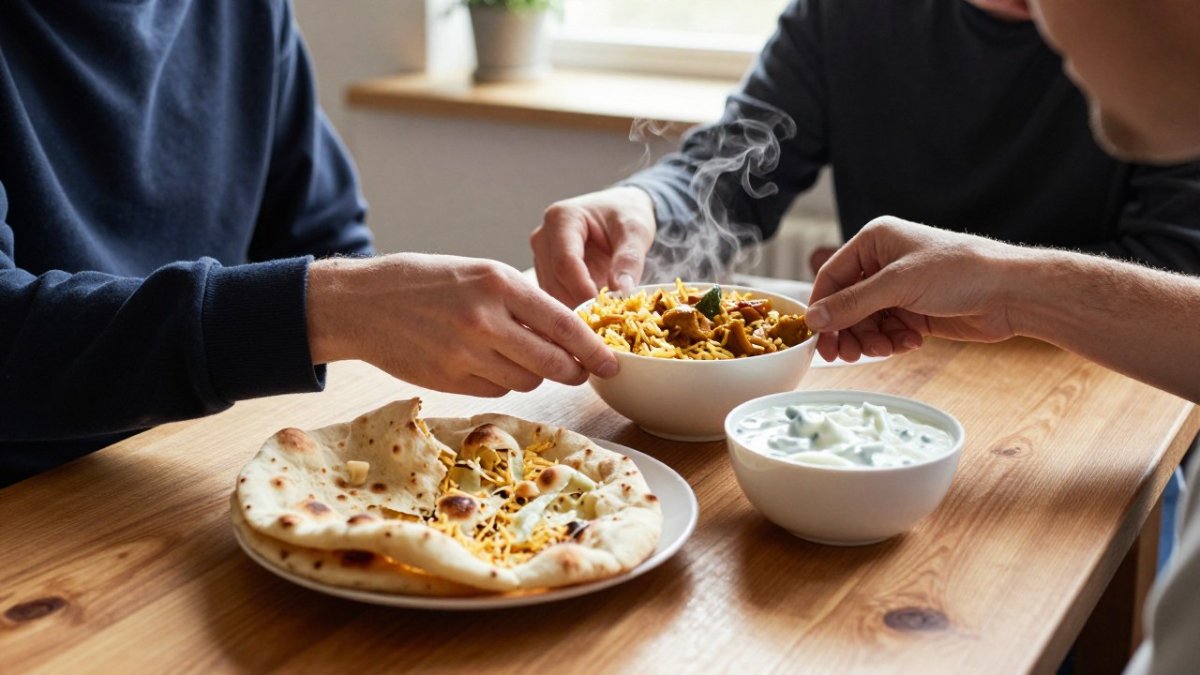
Indian takeaway sides turn a single curry into a proper spread. Rice and bread are the base, but dal, raita and vegetable dishes add balance and stop the meal feeling one-note.
Our picks:
- Naan or roti: scoop and mop up sauce
- Basmati rice: plain or pilau, one portion per person
- Dal: slow-cooked lentils, comforting and filling
- Raita: cooling yoghurt with cucumber, balances heat
Watch out: ordering naan and rice for everyone often leaves leftovers. One bread and one rice per two people is usually enough. If you want to keep things lighter, our guide to avoiding oily Indian takeaway meals covers smarter side choices.
Indian Takeaway for a Group: Portions, Sharing and Budget
Indian takeaway for a group works best when you order to share rather than one dish each. Shared curries, a stack of breads and a few rice portions feed a crowd and let everyone try more. The trick is matching the number of dishes to the number of people and the appetite in the room, then building in one extra side rather than one extra main.
For a group of four, a simple rule:
- Two starters to share
- Three or four mains, mixed mild and medium
- Two rice portions and three breads
- One dal and one vegetable side
This helps avoid waste. Pricing depends on portion size and dish choice, so check the website for current prices when you order. Planning a birthday gathering for twenty? A shared spread creates that celebratory feel.
| Group size | Starters | Mains | Rice | Breads | Sides |
|---|---|---|---|---|---|
| 2 people | 1 | 2 | 1 | 2 | 1 |
| 4 people | 2 | 3-4 | 2 | 3 | 2 |
| 6 people | 3 | 5 | 3 | 4 | 3 |
Sample orders you can copy
General rules only go so far. Here are worked examples for the situations most people actually order for.
One person, first time: one mild curry (korma or butter chicken), one plain naan, one portion of pilau rice, and a raita. This is enough for a full meal with a little rice left over, and it lets you taste the sauce without committing to a whole spread.
A couple, one mild and one medium: one korma, one tikka masala, one naan, one roti, one pilau rice and one dal. Share the rice and breads, keep the curries separate, and you each get the heat level you want.
A family of four with children: two mild mains (butter chicken and korma), one medium main (rogan josh) for the adults, two rice portions, three breads, one dal and one portion of tandoori chicken to share. Children often prefer the grilled items and the bread, so a tandoori dish earns its place even when the adults want sauce.
A mixed-diet group: one meat curry, one vegetarian curry, one tandoori or grilled dish, one dal, two rice portions and three breads. Ordering one vegetarian main by default means nobody at the table is left with only sides, and it usually costs less than adding a second meat dish.
Budget and portion planning
Portion sizes vary between kitchens, so treat the table above as a starting point and adjust after your first order. A common pattern is that groups over-order rice and bread and under-order vegetables; one rice portion per two people and one bread per person is usually closer to right than one of each per person. If you are feeding a crowd on a budget, build the order around one or two curries, a large rice, several breads and a dal, the dal and bread do the filling work at a lower cost than extra mains. Check current prices on the full menu when you order, since they change with ingredients and season.
Recommended takeaway portions by group size
Allergens, Dietary Needs and Getting the Order Right
Allergen questions matter more with takeaway than dining in, because you cannot see the dish being made. Always ask before you order, especially for nuts, dairy and gluten.
Many curries use cream, yoghurt or ground nuts. Korma and pasanda often contain nuts. Breads usually contain gluten. If you are vegan, ask which dishes are cooked without ghee or dairy, and check that vegetable dishes are not just an afterthought.
The Food Standards Agency advises people with food allergies to check ingredients directly with the restaurant before ordering. We would add one more tip: order early and mention allergies clearly, so the kitchen can prepare properly. For quick answers on specific dishes, our FAQ page covers common dietary questions.
Placing Your Mezwaani Order for Collection or Delivery
Placing your order is the easy part once you know what you want. Order online for collection or delivery, and your food can be ordered fresh to suit your timing. The practical decisions that follow, timing, packaging, and what to do when the food arrives, are where most takeaway orders go right or wrong.
A few practical tips for ordering Indian takeaway in Sheffield:
- Check that your address is covered before you build your basket
- Pick your spice levels as you add each dish
- Note any allergies in the order comments
- Consider collection if you would prefer to pick up your order yourself
Delivery times and when to order
Delivery times can vary, so it is sensible to order a little earlier than you think you need to, particularly when feeding a group. Check the website for current opening hours and ordering information.
Packaging: what travels well and what does not
Many Indian takeaway dishes travel reasonably well because many are sauce-based. The exceptions are the items that rely on texture:
- Breads: naan and roti soften in a closed container because steam has nowhere to go. Consider keeping breads separate from hot curries, or leave the bag open for a minute when the food arrives.
- Fried starters: onion bhaji, samosas and pakoras can lose their crunch as they cool, so eating them soon after arrival is a good idea.
- Biryani: the layered rice holds up well, but keep it covered so it does not dry out.
- Raita and chutneys: always transported cold and kept separate from hot dishes.
Watch out: if you order a large spread, the last container opened may have cooled while you unpack the rest.
Reheating safely
If you have leftovers, cool them quickly and refrigerate within two hours. Reheat curries until they are piping hot all the way through, and reheat rice only once, the NHS guide to food safety sets out the basic rules. Breads reheat best wrapped in foil in a low oven; fried items in a hot oven for a few minutes. Avoid reheating raita or anything that was served cold.
If you are new to online ordering, our step-by-step Sheffield ordering guide walks through postcodes, costs and gluten-free options.
Frequently Asked Questions
What should I order from an Indian takeaway for the first time?
Start with a mild curry such as a korma or butter chicken, add a plain or peshwari naan and a portion of pilau rice, then pick one side like raita or dal. This gives you a creamy sauce, a bread, a rice and a fresh accompaniment without overwhelming your palate. If you want to try something grilled, add a small tandoori starter to share. Ordering one dish per person plus a bread and rice to share is a reliable starting point for two diners.
Which Indian takeaway dishes are mild?
Korma, butter chicken, pasanda and most dal dishes sit at the mild end of the menu. Biryani can be mild or medium depending on the kitchen, so ask before ordering. Avoid dishes labelled vindaloo, phaal or madras if you want little heat. When you order, state your spice preference clearly.
How much food should I order for a group?
For a group, plan roughly one main dish per person plus one extra main for every four people, then add rice and bread to share. Two to three Indian takeaway sides, such as raita, chutney and a vegetable dish, cover a table of four comfortably. If you are ordering Indian takeaway for a group of eight or more, plan portions carefully and allow extra time.
How can I make sure my Indian takeaway order is correct?
Read the order back before paying, note any allergies or dietary requirements in the special instructions box, and check the confirmation email item by item. Keep your order confirmation to hand so you can check it on collection or delivery.
